Contents & Overview
Introduction: A Note On Flicker Drive
Fire-gazing in human evolution; flicker’s self-healing and creative effects.
What To Expect
Visualizers vs. verbalizers; strobe as a psychedelic; ganzflicker; rewiring by regular practice.
Foundational Principles
Styles of attention—moving from focused attention to immersive absorption;
Transcendent trance music;
Mantra scripts—relaxation mantras, affirmation mantras, visioning mantras, cosmic mantras;
Advancing to complex imagery—progressing from elementary to complex levels of ganzflicker-induced imagery.
The Pre-Flicker
Preparation of your phone & positioning it in the headset.
The Flicker Run
Mission parameters—navigation, flight duration, frequency, breaks, re-entry;
Adopting a comfortable launch position;
Focused attention on the strobe mandala WITH YOUR EYES OPEN.
Flicker Jumps
Occultation—alternating eyes open & eyes closed—brightening the luminous mist and facilitating the emergence of visions.
Eye Flicking Phases
Flick the gaze from side to side to neutralize negative images and feelings—Eye Movement Desensitization.
Relaxation By Mantras
Link to REM Autogenics exercises—arms and legs heavy—arms and legs warm, clear, light—combining into the single mantra “Heavy Warm … Clear Light”—correspondence with the Four Elements of the imagination—Earth, Fire, Water, Air.
Blank Gaze (unfocused attention) & Luminous Mist
Unfocused gaze—relax the eye muscles; the ganzfeld—the luminous mist.
Unconditional Acceptance Of All Visions
Emotional Operating Neurocircuits (EONs); allow negative EONs to play themselves out.
Immersive Absorption In Mystic Light
Ascent to the numinosum; mystic bright light experience.


Much further back, in prehistory, we have the cave fire, a red-orange light, flickering at similar rates to those of the electrical rhythms of the brain, the alpha, beta, theta and delta which are measured by the electro-encephalograph (EEG). Recent discoveries suggest that man has made use of fire for one and a half million years. Countless long evenings in the winter months must have been spent around the cave fire dreaming stories of gods and heroes and one could guess that, with music, this must have been the first meditation.
Geoffrey Blundell. The Therapeutic Strobe
We humans are storytelling creatures. Our cultural evolution (and perhaps even our cerebral evolution) has been guided by aeons of sitting around campfires, sharing our deepest perspectives about the worlds in which we live.
Jaak Panksepp, Affective Neuroscience:
the Foundations of Human and Animal Emotions
Introduction: A Note On Flicker Drive
Over aeons of fire-gazing our ancestors dreamt the images conjured by the music and storytelling of clan and family gatherings around campfires and hearths. The more imaginative of them became immersed in visionary worlds. The flickering light of fires and lamps helped intensify and animate their visual imagination and propel them into alternate realities and spirit worlds. Today, in ganzflicker meditation, we use the propulsion of Flicker Drive.
The term ‘Flicker Drive’ comes from Russell Hoban’s visionary science fiction novel Fremder (German for stranger), where flicker is a means of intergalactic space travel—a way to jump through the gaps in flickering space-time and cover vast distances in the twinkling of an eye. I have borrowed Hoban’s concept as a metaphor for the journey induced by ganzflicker meditation, where rhythmic light propels us through shifts in consciousness toward states of trance and transcendence. Throughout this page, we’ll draw on quotes from Hoban’s inspired novel, letting his marvellous prose enrich and enliven the otherwise rather dry and dull instructions.
It’s the flickering that gives the excitement. Being is not a steady state but an occulting one; we are all of us a succession of stillnesses blurring into motion with the revolving of the wheel of action, and it is in those spaces of black between the pictures that we experience the heart of the mystery in which we are never allowed to rest.
— Fremder
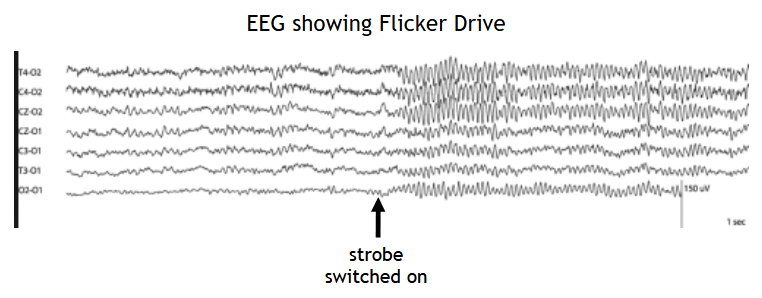
Flickering light drives the electrical rhythms of the brain into amplified synchrony and synchronicity. It gives the brain’s self-organizing electrical rhythms the welcome opportunity to resynchronise to a beat, to reset temporally into greater harmony and deeper connection, releasing visions and strong feeling-states in the process.
This creative visioning of the human brain has evolved over aeons of sitting around fires in dim flickering light while drifting in and out of dream-like hypnagogic states of deep feeling and emotion. Before the industrial revolution and the advent of artificial lighting, much more of life was spent in dim twilight zones of liminality. Research into hypnagogia shows that the visioning so induced in twilight states has both healing functions and creative functions. The traumas, triumphs and tribulations of tribal life wwould ahve been played out and resolved in the hallucinatory visions of our ancestors’ fire-gazing.
And many of the innovative eureka moments propelling the cultural and technological evolution of our species must have emerged while drifting through the hypnagogic states of fire-gazing reverie. Perhaps the first wheel in prehistory was visioned revolving above a fire in much the same way as Kekulé’s benzene ring. And then later on someone else saw the other three.

Visioning, the seeing of pseudo-hallucinations, would have been heavily selected for in evolution, as highly advantageous to survival. The human brain has evolved to journey into other worlds and become inspired in an ambience of flickering light. Flicker drives the natural evolution of the human brain on its creative journey towards enlightenment.
Let us imagine a small band of ancestors, sitting around a fire in the middle of the night with nothing better to do than getting absorbed in the fluid movement of the flames. Some may have fallen asleep, while others entered an alternative reality in which they would experience strange phenomena. This might well have been our first departure from the concrete physical animal world into the symbolic human mental world. Fire was considered holy and associated with divinity probably because it came from heaven, like lightning falling in a tree, but I prefer to think that the fascination induced by fire is at the root of a collective state of worship that evolved into religions. I fancy that the first Buddhist monastery was born by chance around a prehistoric bonfire, long before Sidartha Gautama was born … …
Luis de Rivera, Autogenics 3.0:
The New Way to Mindfulness and Meditation
Why all this emphasis on fire-gazing? Two reasons. First, ganzflicker meditation can seem disconcertingly high-tech and artificial at first encounter—yet the phenomenon it accesses may be among the most ancient and natural responses of the human brain, a direct evolutionary inheritance from those countless firelit evenings our ancestors spent entranced by the moving flames and glowing embers of campfires and domestic hearths. The technological stimulation is relatively simple and straightforward—just red flickering light, replicating in a more controlled and uniform way what fires have always done. Second, I confess these instructions have grown rather long and unwieldy. Don’t let the length put you off—ganzflicker itself isn’t complicated.
For those of a TL;DR mindset: line up an uplifting playlist of music in the earphones, don the headset, and simply gaze at the flicker screen as you would a campfire—relaxed body, blank gaze, blank mind. Your brain has evolved over aeons to respond to flicker of its own accord by moving into beneficial states of reverie and relaxation. You don’t need to do anything . . . but then again, you would get much more out of it if you knew how to flicker jump . . .
We don the headset, set off on a trip; and when we get back and take the headset off, we find we’re somewhere else. We’ve shifted into a better state of consciousness.
Here’s the rest of ‘A Note on Flicker Drive’. It’s all right as far as it goes but it doesn’t tell you what it’s like to flicker: you hit the switch that disappears you and if everything goes all right you reappear somewhere else.Russell Hoban, Fremder
What To Expect
Visualizers versus Verbalizers
When you first don the headset, your experience will depend on how your brain has been shaped by life. Natural visualizers—those who’ve maintained the vivid imagery of childhood—may find themselves immersed in the imagery of Flickerspace almost immediately. Others, particularly those whose years of education and text absorption have developed exclusively verbal, left-brained processing, may initially see nothing at all. This is not failure. It is simply a different starting point on the journey.
Progress through the levels of ganzflicker visioning is mapped out in detail here:
Most strobonauts find themselves somewhere between these extremes, with imagery emerging intermittently during sessions, sometimes activated emotionally by music, and gradually intensifying with practice.
The Journey: Rewiring Through Regular Practice
While a medical student back in the 1970’s I had life-changing experiences with psychedelic drugs and became aware of just how powerful they are as a treatment method. As a psychiatrist however I was not allowed to use psychedelics, and so instead used stroboscopic stimulation, in the form of high brightness LED glasses, to help patients access visual imagery from the unconscious.
Click on the yellow button for a review paper on strobe’s psychedelic effects:

During my years integrating the psychedelic effects of stroboscopic stimulation into EMDR psychotherapy, I worked with many patients who could access no visual imagery whatsoever at first. Some were on the autistic spectrum, markedly left-hemisphere dominant. Those who practised flicker meditation regularly—daily or near-daily, combined with Autogenic Training and transcendent music—developed the capacity to access complex visual imagery gradually over months and years of practice. I believe that this therapeutic progress would have been considerably faster if I had been allowed to prescribe small sub-perceptual doses of psilocybin, or other psychedelic drug, to act in synergy with the strobe.
It would also have been faster if I had used ganzflicker instead of strobe. Both flickering light and the ganzfeld have hallucinogenic effects. Their synergistic combination, ganzflicker, a term coined by Reshanne Reeder, is therefore exceptionally effective for inducing visual pseudo-hallucinations. Click on the yellow buttons below for journal articles about ganzflicker’s imagery effects:

The progress my patients made with regular practice of stroboscopically-enhanced meditation wasn’t merely about seeing pictures. As their imagery awakened, so did their emotional range. They became more embodied, more empathic, more socially attuned—pronounced all round improvement in global functioning. The brain was rebalancing itself, right hemisphere capacities flowering alongside the dominant left.
Openness and Absorption
You might also understand these transformations through the lens of psychedelic therapy research. Like the effects of psychedelic medication, long-term flicker meditation appears to enhance the personality dimension psychologists call Openness—receptivity to new experience, aesthetic sensitivity, depth of feeling. This personal growth correlates strongly with how deeply you experience Absorption during sessions: that quality of losing yourself completely in Flickerspace, becoming emotionally engaged with imagery rather than merely watching it.
Foundational Principles
Styles Of Attention
To cultivate ganzflicker visioning, you move from focused attention to immersive absorption through a sequence of attentional styles.
Focused attention is deliberate and effortful. It involves consciously directing your awareness to a specific target—in this case, the strobe mandala at the center of the flicker screen—and actively maintaining that concentration over time. This is the familiar mental state of doing something: reading a book, solving a problem, following instructions. Cognitive effort is required. Distractions must be resisted. This is a necessary first stage in order to leave behind concern with the outer world and focus exclusively on the inner world of Flickerspace.
By then relaxing and allowing your gaze to unfocus, your concentration becomes more passive, receptive and effortless. By investing total attention to the flicker, regarding it as highly important to you, you begin to become emotionally engaged with it and entranced by it. The spotlight of your attention then remains fixed on the flicker without any effort on your part. Immersive absorption is spontaneous and effortless. Like when absorbed in a good movie, you do not need to make an effort to resist distractions. The experience unfolds of its own accord.
These five stages map this journey:
- Focused Attention
- Relaxation By Mantras
- Blank Gaze (unfocused attention)
- Unconditional Acceptance Of All Imagery
- Immersive Absorption Into Flickerspace
Those high in the personality trait of Absorption—natural visualizers, daydreamers, those who easily lose themselves in music or art—may find this transition happens quickly and spontaneously. For others, particularly those whose education has developed exclusively verbal, left-hemisphere processing, the journey is longer. With daily practice combining flicker meditation with Autogenic Training and transcendent music, the capacity for immersive absorption gradually awakens over months and years of regular practice.
Transcendent Music
As she sang wordlessly the flickering 1/f music counter-pointed her song and the pixels changed colour and pattern in a visual continuo.
— Fremder
Transcendent music is central to the art of ganzflicker visioning. The immersive absorption of ganzflicker puts the strobonaut into an altered state of consciousness, a trance state. Transcendent music acts as a powerful positive hypnotic suggestion to ensure that the trance has a positive outcome so that, after the flicker run, you feel better and have become better.
Brain imaging shows that flicker light stimulation enhances the emotional response to music in a manner similar to psychedelic drugs:
Music is the numinosum! It is absolutely of spirit! It is much more important than reading psychology!
Gerhard Adler, The Numinosum in Everyday Life
Mantra Scripts
Silent inward repetition of mantras is also central to the art of visioning—cultivating a blank mind during a flicker run and so facilitating the ability to see visions. Paradoxically, to liberate oneself from the constant internal chatter of compulsive verbalization, the endless thinking of the SEEKING ego, one uses words! During practice of ganzflicker meditation, repetition of a mantra serves as a vehicle for the progressive fading of the ego’s compulsive verbalization. The mantra keeps the compulsively verbalizing part of the ego fully occupied and busy, and with sufficient repetition of the same word or phrase over and over again the verbalizer becomes deflated, loses self-importance and runs out of steam. The verbal thoughts fade and only their prosodic rhythm remains, and then that fades too, so that only pure awareness, a blank neutral mind, remains—leaving an empty space, free of censorship, in which the visions can emerge.
Develop your own mantra script—a sequence of different types of mantra used at different times during a flicker run.
- Relaxation Mantras—physical and mental relaxation—used at the start of a strobonaut trip, and when resuming Flicker Drive after a phase of Eye Flicking, or after a tea break;
- Affirmation Mantras—motivational, strengthening intent—used when deep relaxation has been attained;
- Visioning Mantras—used when moving into visioning, e.g. repeat prompts to yourself “I am seeing clouds in the flicker screen“, “Now seeing shapes in the clouds“;
- Cosmic Mantras—visioning—facilitate the natural progression of hallucinatory imagery towards the numinosum and mystic bright light experience; may be a traditional mantra of a religious faith.
The founders of all of the world’s major religions—Hinduism, Zoroastrianism, Judaism, Buddhism, Daoism, Christianity, Manichaeism, and Islam—were inspired to do what they did by seeing a vision of fiery light. These visions were said to be so unlike any lights seen in nature that the seers understandably concluded that the visions must have come from God or from some other supernatural agent and that therefore they must encode some divinely inspired message that needed to be deciphered. Many other mystic seers also saw visions of fiery light and used their visions, not to found new religions, but rather to revitalize their existing traditions. Visions of fiery light continue to be prized today by all of the world’s major religious traditions as being among the most powerful of all human mystical experiences.
Philip Nicholson, The Inner Light and World Religions
Detailed instructions on progressing through a sequence of Relaxation Mantras—inducing in turn sensations of Heavy, Warm, Clear, and LIght—corresponding to the four elements of the imagination—Earth, Fire, Water, and Air— can be found at the REM Autogenics website:
Further information on more general Affirmation Mantras and Cosmic Mantras (e.g. from religious traditions), with tables of examples of the most commonly used mantras, can be found on the Mantra Scripts page at REM Autogenics:

Advancing To Complex Imagery
The Frustration of Remaining at Elementary Levels
Many strobonauts express frustration with stroboscopic meditation because they find themselves unable to progress beyond the elementary levels of visioning—the ever-changing swirl of vibrant hues and vivid patterns—to the complex imagery of seeing scenes and filmstrips, as in a waking dream.
Often these practitioners have been using exceptionally bright strobic stimulation, of an intensity that is certainly conducive to producing a psychedelic kaleidoscope of colours and patterns. This apparent psychedelia can provide a worthwhile focus for contemplation. Unfortunately, however, it creates a problem: the practitioner becomes so flooded in brightness from the stroboscope that the more subtle variations in projected brightness are obscured. With a fainter ganzflicker field—as from a smartphone screen—one can observe the field itself growing dimmer and brighter. In other words, one can readily distinguish one’s subjective luminosity from the objective brightness of the ganzflicker screen.
This distinction is fundamental. To try and go straight to seeing pictures without first increasing subjective brightness is like putting slides in a slide projector without actually turning the lightbulb on.
The Pathway: From Mandala to Luminous Mist to Complex Visions
To move from elementary levels of visioning to complex levels, you must cultivate the capacity to project your own inner light into Flickerspace. The progression follows naturally through the stages described below:
1. Observe the Strobe Mandala’s Rhythms
Find the strobe mandala as described in the Focused Attention section. Simply observe the way the mandala goes through phases of brightening and darkening. This fluctuating variations are your brain’s response to the flicker emerging as underlying positive and negative feeling states—watch the variations with close attention, without trying to change them.
2. Dissolve Into the Luminous Mist
Once you have become immersively absorbed into Flickerspace, you will find the strobe mandala disperses into a whitish luminous mist, as described in the Blank Gaze section below. This is the ganzfeld—the “sea of mist” that researchers have consistently observed since the 1930s as the characteristic first stage of hallucinatory experience.
3. Brighten the Mist Through Occultation
Here is where many strobonauts fail to progress. The luminous mist, when first encountered, may be quite faint and grey. Use frequent flicker jumps—6 times or more during each flicker run—to progressively brighten this inner light. Close your eyes for brief rest periods, then reopen them onto the flicker screen, and wait 20-30 seconds for a delayed effect. Watch for the spontaneous increase in brightness that follows (described fully in the Flicker Jump section below).
4. Facilitate the Emergence of Forms
Once the luminous mist has been brightened by repeated flicker jumps, use visioning mantras to facilitate the emergence of shapes, forms, and figures. Begin by repeating simple prompts to yourself: “I am seeing clouds in the flicker screen,” “I am seeing shapes and shadows in the clouds.” As forms begin to coalesce, allow them to develop without forcing or grasping. The imagery will naturally fluctuate back and forth between vague shadows and more defined shapes, with gradual progression over time, evolving eventually into complex scenes and narratives.
The key is patience and the recognition that you are cultivating an inner projector as well as passively watching an external screen. With regular practice, the lightbulb of subjective luminosity grows progressively brighter, and the slide shows and movies of complex imagery can finally be properly illuminated and seen.
I speak only in pictures. With me the image is everything, carrying within it as it does the proto-image, the after-image, and the anti-image.
Russell Hoban, The Medusa Frequency
The Pre-Flicker
Preparation Of Your Phone
- Ensure that the screen of your phone is clean.
- In Settings have Display / Brightness turned up to 100%.
- If the phone has an ‘Adaptive Brightness’ or ‘Auto Brightness’ feature, turn this off.
- Start the music playlist or other audio through earphones or headphones if using it.
- Open the Strobonaut app. With many smartphones, Strobonaut only lifts off from a launchpad that is perfectly horizontal in relation to the gravitational field of the planet or space station you are on. Have your smartphone laid flat on a table or hold it horizontally when you open the app. It opens in Eye Flicking mode. Tap the screen once to switch to Flicker Drive.
- When putting the phone into the headset, align the central line in the flicker screen to the centre of the headset before you close it.
We’d done the pre-flicker and we were ready to go. I set the frequency. . . . Everybody always tries to look as if it’s nothing special but no matter how many times you do it you can’t help wondering if you’re going to come out of it the same as you went in.
— Fremder
The Flicker Run
Mission Parameters
Navigation
Before starting out on a strobonaut trip set a clear sense of direction. Give yourself a destination. Align your intent, the arrow of your Will, to the cosmic map right at the start by saying to yourself something along the lines of one of the following:
“The visions will flow better this time”
“I’ll do six flicker jumps this trip without distractions”
“My concentration stays on focus much better this time“
“I will clear this depressed feeling”
“The anxiety will shift”
“I will get help making a decision about . . . “
“Good ideas and inspiration will come to me about . . .”
And imprint that intent firmly into the felt-sense of your solar plexus.
Flight Duration
Strobonaut trips might initially be short, lasting only 20-30 minutes, with perhaps only four flicker jumps.
With practice they are built up to somewhere between 40-90 minutes, with over six flicker jumps.
The length of a flicker run can be preset by using the duration of a music playlist.
So far there are no known adverse effects of too long a session of ganzflicker meditation using the relatively gentle level of light intensity emitted by the screen of a smartphone.
Frequency
As with learning to play a musical instrument, ideally one practises every day, or almost every day. At about the same time each day. In the same place each day. And in the same body position each day. The three R’s—Repetition, Routine, Ritual—are essential for effective trancework. One builds an altered state of consciousness by the repetition of auto-conditioning.
Breaks
Taking a break for a cup of tea, or whatever, halfway through a long flicker run is sometimes helpful, perhaps surprisingly, in raising the level of visioning. The visions often seem to become more vivid and flow better after a break.
Re-entry
Take a deep breath and have a long leisurely stretch of your whole body when taking the headset off at the end of a trip. Stretch all your muscles to ground yourself firmly back into your physical body and the external world.
Adopt A Comfortable Launch Position

‘I’m going to go deeper than before,’ said Pythia. ‘Just let yourself go loose and floaty, think of all the nice flickering we’ve had and all we’re going to have. Are you lying comfortably?’— Fremder
The traditional meditation posture in both Western (dream incubation) and Eastern (yoga nidra) practices of liminal dreaming is to lie supine in a straight, symmetrical, and slightly spread-eagled position.
Adopting the same position each time helps cultivate a habit of deep stillness in mind and body, an auto-conditioned response.
Psychology research has shown that visual imagery emerges more readily in the lying down position as compared to the sitting position. Study of physiological responses comparing sitting and lying postures for meditation shows that the lying posture elicits stronger relaxation responses, with greater meditation depth and increased parasympathetic activation. And a VR headset rests more comfortably when lying back.
Practise ganzflicker meditation in bed, on a couch, or in a recliner. Make the trip into Flickerspace as comfortable and as enjoyable as possible.
Focused Attention On The Strobe Mandala

To the conscious mind the mandala appears first as an unimpressive point or dot, and a great deal of hard and painstaking work as well as the integration of many projections are generally required before the full range of the symbol can be anything like completely understood.
Jung, Aion
Just as you might practise focused meditation (samatha) by fixing your gaze on the flickering flame of a candle, so when using the Strobonaut  app in a Virtual Reality headset you practise ganzflicker meditation by fixing your gaze on the centre of the flicker screen WITH YOUR EYES OPEN.
Extracts from the literature advocating eyes open for accessing complex visual imagery:

As with the hallucinations induced by any type of psychedelic agent there tends to be a central focus to flicker visions, a dot or central circle of light. The strobe mandala is not present objectively in the flicker field of the phone screen. It is a subjective phenomenon, a phosphene, projected by the brain. It comes about as a result of the concentric arrangement of the retina and visual system, an entoptic phenomenon.
If you cannot find the strobe mandala at first, slowly jiggle your head a little from side to side looking into the distance beyond the centre of the screen. Look for a faint dot or blob, slightly brighter or darker than the rest of screen, and remaining absolutely stationary, a fixed reference point which ignores the movement of your head.
As you move your head, imagine the headset is a set of goggles, like diving goggles. Notice that the Flickerspace around you does not move with your head; it is stationary and fixed, a virtual outer world surrounding you. Right from the start, begin developing a sense of being immersed in Flickerspace. If distracted by the patterning of your phone screen, look beyond it into the distance.
On the screen the circles were widening, growing larger, becoming great eyes of becoming that became vast nodes of possibility and archipelagos of being constantly expanding and mutually annihilating as they slowly faded into blankness.
— Fremder
Flicker Jumps
Occultation: Alternating Eyes Open & Eyes Closed
‘You’re shaking,’ she said as she smeared me all over with electrolytic cream.
‘Don’t take any notice of it – it’s just something I do between flicker jumps.’ She was very thorough and although I was feeling more and more nervous about the Pythia session it was evident that my body was getting interested.
‘See,’ she said with a big smile, ‘you’re feeling better already.’—Fremder
Use Flicker Jumps to brighten the screen and facilitate the emergence of visions—close the eyes for a period of deep rest, then re-open them, and wait for a delayed effect.
Development of visioning can be accelerated by using Flicker Jumps—closing the eyes for a brief time, then re-opening them, and then observing closely as you wait for a delayed effect. When your eyes are closed the alpha rhythms in your brain are double the size of when your eyes are open. When reopened onto an unstructured ganzflicker field, there is alpha blocking for 20 or 30 seconds and then alpha rebound occurs, and Flickerspace becomes noticeably brighter.
Use an intermission of several minutes of eye closure and deep rest to promote brightening of the luminous mist.
STEP 1:
Close your eyes for a few minutes and give way to complete rest. Immerse yourself in the music. Become the music.
STEP 2:
Open your eyes and take note of the colour and brightness of the flicker screen.
STEP 3:
Begin inwardly reciting REM Autogenic Exercise 4 and wait for a delayed effect:
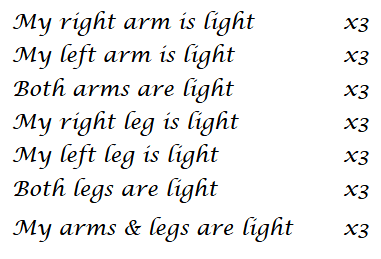
Watch for an increase of brightness of the screen near when you get to “Both arms are light” depending of course on your rate of recitation.
Alternatively begin counting slowly when you open your eyes, and look for brightening at a count of about 15 or 20.
STEP 4:
Continue meditation with the mantra “Heavy Warm” on the in-breath, “Clear Light” on the out-breath.
STEP 5:
Watch for visions emerging within the brightness.
Repeat the procedure every time Flickerspace goes dim and dark.
Aim to do 6 or more flicker jumps in a meditation.
For details of all the REM Autogenic Exercises goto:
Then she left. I liked her going-away view and the sensors put that up on the pixels briefly before they went into a flicker pattern of expanding and contracting shapes and colours, glimmering and occulting: yes/no/here/gone. Except, of course, for the places where the circles of bright emptiness came and went.
— Fremder
Eye Flicking Phases
Flick flick, flick and fade, John,
flick and fade.
Flick flick, flick and fade, John,
on the planet where you are.— Fremder
Eye Movement Desensitization
Concentrate your awareness and focus on the breath.
Through different eye-gazes and concentration practices,
Discipline your mind until it rests naturally.Oral Instructions on Mahamudra given by Tilopa to Naropa
at the Banks of the Ganges River, circa 1040
If the trip turns bad, switch into Eye Flicking Mode for 20-60 seconds and do a set of eye movements.
If you begin experiencing:
(a) strong negative feelings of anxiety or panic during a trip, or
(b) distressing, frightening, or overwhelming images,
switch the Strobonaut app immediately into Eye Flicking Mode by pressing the touch button on the Destek V5 headset. On other headsets use a bluetooth mini-controller paired to your phone, or voice commands, to switch the app between Flicker Drive and Flicking mode.
If all else fails resort to manual switching—open your headset and switch between modes by tapping the screen of your smartphone.
With eyes open, flick your gaze, your focused attention, horizontally from side to side fixing on the vertical red bars.
As you flick the laser beam of your gaze back and forth with accuracy and extraordinary precision, summon feelings of calmness, power and control. Have the feeling of flicking the bad stuff away, flicking it out of your body. You may find your body, and particularly your spine, wants to straighten up or spontaneously move as you do this.
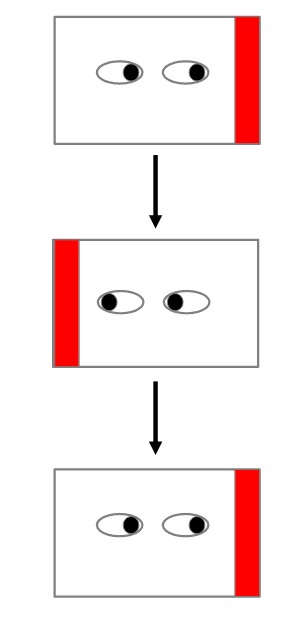
Carry out eye movements for 20-60 seconds and then switch the app back into Flicker Drive. Observe the brightness of the flicker field. There is a transient darkening following a set of eye flicking until you have settled back into meditation.
Sometimes you may find that your body wants to move about as you do the eye movements. Allow that to happen. Let it stretch and flex to offload any accumulated muscle tension. You may also find that sometimes you need to say things repeatedly, curse, swear, mutter, moan, groan or cry to offload FEAR, GRIEF, or ANGER during the Eye Flicking phases. Offload random rubbish noise and random rubbish movement as much as you need to, but keep the Eye Movements going so that a part of you stays calm and in control. If it gets too noisy, you may need to keep the dog and the parrot out of the room during a trip.
If strong emotion surfaces during an Eye Flicking phase, look for visions related to it once you are back in Flicker meditation. The visions may be dark so do a few flicker jumps to brighten and lighten up the Flickerspace.
Relaxation By Mantras
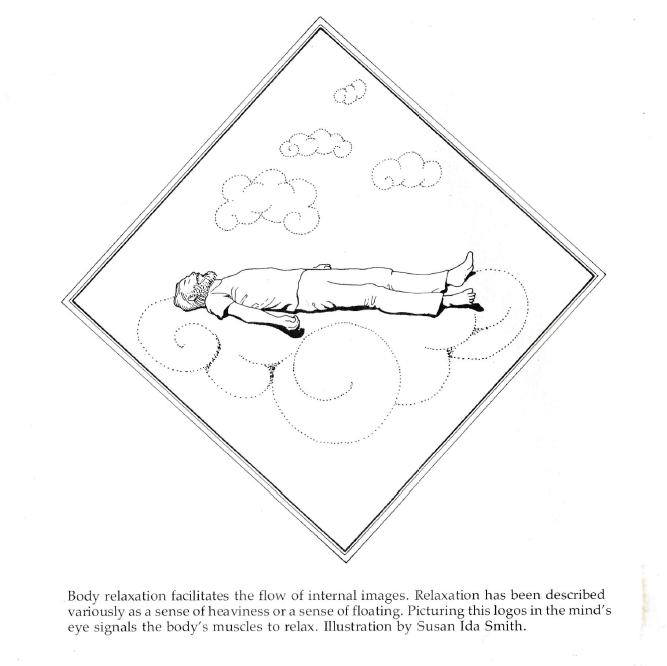
Relax completely your mental hold of, or awareness of, all bodily sensation.
An easy and effective way to do this is to use REM Autogenics, a system of mantras developed for visioning work. Click on the blue button for access:
Research studies have shown that the first exercise of REM Autogenics, Heaviness in the limbs, is effective in facilitating access to visual imagery. These autogenic mantras are recited silently in the mind whilst focusing both on the felt sense of the relevant part of the body, and on the flicker screen:

For detailed instructions on these exercises go to REM Autogenics:
‘Listen to the flicker pattern, look at the colours: there’s no picture now. Whatever comes up is from you. Close your eyes, I’ll tell you what I see; let yourself go empty as we go down, down, down, down to meet whatever’s coming up. How do you feel?’
— Fremder
Blank Gaze & Luminous Mist
The process which is ego actually consists of a flicker of confusion, a flicker of aggression, a flicker of grasping — all of which exist only in the moment. Since we cannot hold on to the present moment, we cannot hold on to me and mine and make them solid things. The experience of oneself relating to other things is actually a momentary discrimination, a fleeting thought. If we generate these fleeting thoughts fast enough, we can create the illusion of continuity and solidity. It is like watching a movie, the individual film frames are played so quickly that they generate the illusion of continual movement. So we build up an idea, a preconception, that self and other are solid and continuous.
Chogyam Trungpa, The Myth of Freedom and the Way of Meditation
- Keep your eyes open and your gaze on the flicker screen but unfocused
- Fully relax and let go of all the muscles around your eyes
- Adopt an attitude of quiet receptivity and total attention
- Become an entranced observer / fascinated spectator
- Practice letting it happen not making it happen
- Blank the mind and blank the gaze
- Watch for the colour to begin draining from the screen
- Less red, more yellow. Less yellow, more grey. Less grey, more white
- The screen becomes a greyish-white luminous mist
- The mist does not flicker — you’ve found the space between the pictures
When I ask people whether they experience being as a smoothly continuous state or a flickering one they all say it’s smooth and continuous for them. For me it’s always been a flickering. Not visually — I’ve never actually seen the black between the pictures in my eyes but I’ve sensed it in my brain and for that reason I don’t make any assumptions about reality. Can it be that the world flickers? Can it be that the chair I sit on is only rhythmically and repetitively but not continuously there? Why don’t I fall to the floor between therenesses? How do I manage to flicker synchronously with the chair?
— Fremder
Luminous Mist
Please, I said to the mind that had spoken to me of the everything-fear and the all-terror, tell me how to be. To my inner eye came white mist on the ancient waters of time’s beginning but there were no words . . .
— Fremder
By meeting Flickerspace with blank unfocused gaze, engaging with it with all of your attention and empathy, free of any distracting thoughts about the outer world, allowing yourself to relax deeply, becoming progressively more immersively absorbed, the red colour of the flicker screen begins to fade. Flickerspace becomes paler and more yellowish, and then as colour continues to drain from it, it goes to a greyish white “luminous mist”.
If unfocused attention to the ganzflicker is sufficiently sustained, and relaxation of mind and body sufficiently deep, the flicker screen mists over into a greyish or whitish mist. This “luminous fog” or “sea of mist” has been consistently described by research studies since the 1930’s as the characteristic first stage of the ganzfeld experience. The augmentation of ganzfeld by flicker leads to ganzflicker-induced visionary progression and a brightening of the mist into the mystic bright light.
I opened myself to her voice, closed my eyes, held the white mist on the water with my inner eye. It was good to see nothing but that, it was restful, I didn’t want to see more. There was music in the Omphalos now, The Art of Fugue.
— Fremder
Unconditional Acceptance Of Visions
Once you have found the luminous mist, look for vague shadowy shapes within it, like seeing castles and dragons in the clouds in the sky.
To promote access to visual iamgery, use visioning mantras—“I am seeing clouds . . . I see a sea of clouds”, “Now seeing shapes and shadows in the clouds”—and give your total attention to even the faintest lines and shapes seen in the flicker. Cultivate a deep fascination with the most trivial of forms. In this way you give them energy; you feed them; and they develop.
Stay with the primary experience; don’t go beyond it into thoughts about it.
Stay happy if you find yourself unable to identify what the shapes are or what they mean. Just enjoy the fascination of watching them with blank gaze and blank mind. You absorb them and their meaning subliminally.
Insights may emerge spontaneously and naturally after the trip, often quite a time after, e.g. upon awakening the next morning. Stay with the primary experience; don’t interpret.
On the Levels of Ganzflicker-Induced Visioning page of this website you will find a map of the different levels of complexity as the visions progress from Elementary Levels (patterns and shapes) to Complex Levels (scenes and filmstrips). Familiarise yourself with its stages. Awareness of them facilitates the progression.
Fully accept and welcome all visions. The more negative they are, the more you are clearing disturbance from the Emotional Operating Neurocircuits (EONs) of the deep brain.
When negative EONs are engaged, the brightness of Flickerspace goes dim and dark.
Strobonautical engagement with EONic darkness uses two technical manoeuvres:-
Use Flicker Jumps when Flickerspace goes dim and imagery fades;
Use Eye Flicking when it goes very dark and distressing images emerge.
Immersive Absorption In Mystic Light
The Evolution of Numinosity into Mystic Light
The world vibrates like a crystal in the mind; there is a frequency at which terror and ecstasy are the same and any road may be taken.
— The Medusa Frequency
Use Flicker Jumps at least 6 times or more during a flicker run to brighten the luminous mist.
Inwardly recite a cosmic mantra, e.g. Bright Jewel Flower Flames (a loose poetic translation of Om Mani Padme Hum), to evoke the numinosum with themes of radiance, unfolding and ascent.
| Om Mani Padme Hum | Bright Jewel Flower Flames |
|---|---|
| 💎 Mani = Jewel, crystal | 💎 Jewel = Inner treasure, clarity |
| 🌷 Padme = Lotus (flower) | 🌷 Flower = Organic unfolding, purity |
| 🔥 Hum = Enlightened mind, power | 🔥 Flames = Awakening, energy, transformation |
| ☀️ Om = Sacred seed sound, unity | ☀️ Bright = Light, source, luminosity |
Symbolic Parallels
- Jewel (mani) and Flower (padme) are preserved directly.
- Flames mirror Hum — the power or fire of awakening, the final “ignition” of transformation.
- Bright echoes Om — the primordial vibration, light of consciousness.
And all shall be well and
All manner of thing shall be well
When the tongues of flame are in-folded
Into the crowned knot of fire
And the fire and the rose are one.Concluding lines of T.S. Eliot’s Four Quartets
As you continue gazing into the luminous mist, the imagery that emerges becomes progressively more condensed, more intricate, more charged with numinous power. Simple shapes give way to elaborate architectures of increasing complexity. You may find yourself swept up into the visions, carried along as though floating or flying, with your sense of separate ego-hood progressively dissolving into the flow of imagery itself.
The visions may evoke experiences of ascent up to the numinosum—rising through vast spaces, staggeringly high mountain peaks, gigantic towering pillars and tree trunks, figures and objects levitating, encountering structures of awesome scale and immense dimensionality which seem to drift through outer space. Characteristics of the numinosum are vastness and flying/floating. Reality itself may seem to shift, as if two or more worlds are superimposed upon one another, interpenetrating through translucent layers that fold and compress like concertinaed space. The imagery weaves together a flux of forms—structural geometries flowing into mechanical assemblages, organic patterns morphing into animal-like or human-like figures, and at times completely alien configurations that defy categorization.
She glimmered in the redness and seemed to increase, to become great and goddesslike. I was entranced by the mystery and dim red magic of her nakedness, by the numen and the treasure of it, by how precious it was to me even though the picture in my eyes swarmed with circles of bright emptiness.— Fremder
All of this carries with it a profound numinous feeling-tone—that characteristic emotion of awe which simultaneously both humbles and exalts the soul. This sense of the numinous, of encountering something mysteriously Other and beyond the mundane world, tends to be deeply salutary to psychological wellbeing. The numinosum in its full manifestation—with its extraordinary structural hypercomplexity and multidimensional unfolding—tends naturally to merge into and be supplanted by the mystical luminosity of Bright Light Experiences.
It should be noted that brightness and structural complexity can at times dissociate from one another. You may encounter elaborate numinous visions in relatively dim light. But with sustained long-term practice of ganzflicker meditation, figures and objects are perceived as progressively more translucent and inherently luminous, with an inner light of their own. Bright Light Experiences become increasingly frequent and prolonged. The intensity builds towards dazzling whiteouts of beatific luminosity—states in which all thought and feeling are supplanted by pure radiant brightness. The Bright Light Experience is the end of SEEKING.
While I am enjoying the spectacle of this light, every sadness and pain vanishes from my memory so that I am again as a simple maid and not as an old woman.
Hildegard of Bingen, 12th century

Thus shall you think of all this fleeting world:
A star at dawn, a bubble in a stream,
A flash of lightning in a summer cloud,
A flickering lamp, a phantom, and a dreamThe Diamond Sutra
If you have any questions, you can contact me at: strobo0pete@gmail.com
 strobonaut.com