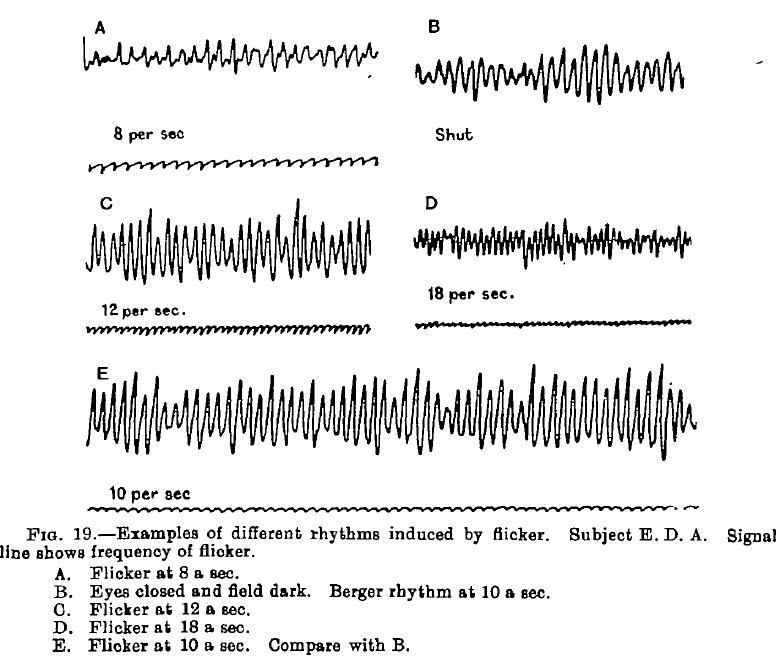
The first EEG recordings of neural entrainment to flicker:
Adrian & Matthews, 1934, The Berger Rhythm: potential changes from the occipital lobes in man
* * * * * * * * * * * * * * * * *
As a safety feature, on most smartphones Strobonaut requires a perfectly horizontal launchpad. The app only opens when the phone is laid flat on a horizontal surface or held horizontally.
* * * * * * * * * * * * * * * * *
General Guidance
- Start with 5-10 minute sessions to familiarize yourself with the experience
- Adjust brightness to your comfort level
- Stop if you experience headache, nausea, or discomfort
* * * * * * * * * * * * * * * * *
Photosensitive Epilepsy
Approximately 1 in 10,000 people suffer from photosensitive epilepsy, a condition in which an epileptic seizure can be triggered by flickering light.
Do not download the app if you think might be at risk, and do not allow children, or family & friends who might be at risk, to use Strobonaut.
An epileptic seizure is a paroxysmal over-synchronisation of the electrical rhythms of the brain. The synchronising effects of stroboscopic light are beneficial for the great majority of people — mental health issues are associated with a lack of synchronisation in the brain rhythms. However a very small minority of people are hypersensitive to the synchronising effects of stroboscopic light and can be triggered into an epileptic seizure.
The most common precipitating causes of photic seizures are the television set and computer monitor. The majority of adults have therefore been well tested for the condition. Flickering light over the entire range of frequencies is now so frequently encountered in the modern world that, for an adult with no history of sensitivity or a reaction, the risk that they suffer from photosensitive epilepsy is very small indeed. However caution is required with those who in the past have felt nauseated or uncomfortable when exposed to strong flicker, e.g. at discos, clubs. Similarly anyone suffering from any form of epilepsy, or with a history of any form of epilepsy in the family, is likely to be at higher risk.
- The risk is increased if a flicker app is used whilst intoxicated with, or withdrawing from, alcohol or drugs.
- Use of flicker apps is not recommended for anyone aged under 18.
There are grounds for believing that people in the modern world are becoming more accustomed to flickering lights and that the risk of photosensitive epilepsy is diminishing.
This reviewer is convinced that there are far fewer patients in the USA in 1993 with a photoconvulsive response of bilateral spike and wave complexes to light flashes, compared to the 3% of all patients with an EEG who showed such a response in the late 1950s. It seems possible that the many examples of flickering lights in our society may be responsible for a partial adaptation to the photic flashes.
EEG in Clinical Practice by John R. Hughes, Professor of Neurology, Director of Clinical Neurophysiology, Director of Epilepsy Clinic, University of Illinois
Of all the many procedures that appear to bring about an equivalent of the naturally occurring hypnagogic state and which, in turn, facilitate the emergence into awareness of visual imagination images, the easiest, safest and potentially most precise in its effects, is photic stimulation (flickering light). Unlike perceptual isolation, hallucinogenic drug intoxication, or sleep onset procedures, photic stimulation does not require a complicated laboratory environment, sophisticated equipment or heavy demands on the time of those taking part.
The effects of photic stimulation and private self-consciousness on the complexity of visual imagination imagery. Professor Alan Richardson, British Journal of Psychology, 1990
* * * * * * * * * * * * * * * * *
Additional Safety Considerations
While photosensitive epilepsy is the primary medical concern with stroboscopic light stimulation, the research literature on high-intensity strobe lamps and LED devices identifies several other conditions where caution may be warranted. However, it’s important to note that Strobonaut uses your phone’s screen, which produces much lower light intensity than the dedicated strobe lamps and LED systems studied in clinical research. Many of the risks described in that literature are therefore less applicable to phone-based ganzflicker.
Sensory Sensitivities
Migraine and Photophobia: If you experience migraines with visual aura or have marked sensitivity to flickering lights, you may occasionally find ganzflicker uncomfortable. While less likely with phone-screen intensity than with bright strobe lamps, if you notice any discomfort, simply reduce the brightness or stop the session.
Neurodevelopmental Sensitivities: Some individuals with autism spectrum conditions or ADHD experience heightened sensitivity to flickering lights. Phone-based ganzflicker is generally well-tolerated, but if you know you have significant light sensitivity, start with shorter sessions and lower brightness.
Psychiatric Considerations
Anxiety: The visual phenomena produced by ganzflicker can occasionally feel disorienting. If you have significant anxiety or panic disorder, start gently to ensure you’re comfortable with the experience. You can stop at any time.
Psychosis: If you are currently experiencing psychotic symptoms, the unusual visual patterns might interact with your symptoms in unpredictable ways. It’s best to wait until you’re in stable remission.
Medical Conditions
Pregnancy: As a general precaution, and in the absence of specific safety data, it’s advisable to avoid ganzflicker during pregnancy.
Recent Head Injury: If you’ve had a concussion or head injury in the past few months and are still experiencing symptoms like headaches or light sensitivity, wait until you’ve fully recovered.
* * * * * * * * * * * * * * * * *
Click the yellow button for recently published safety guidelines:
* * * * * * * * * * * * * * * * *

 strobonaut.com