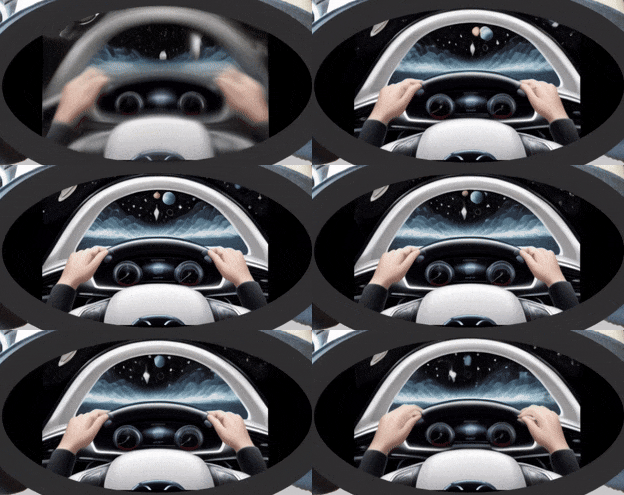
YES! bellowed the mind in my head, SAY IT, SAY THE EVERYTHING-FEAR, THE ALL-TERROR. I TOO FEAR EVERYTHING. I FEAR MY LONG-AGO BEGINNING AND THE AWAKENING OF DREAD, I FEAR THE UNCEASING BECOMING OF ME. I FEAR THE HUGE AND THE TINY, THE FAR AND THE NEAR OF ME, AND I FEAR THE MOMENT THAT IS NOW AND NOW AND NOW WITHOUT RESPITE.
The power of that utterance and the relief of it! With those words my fear seemed all at once a mighty fortress in which I was no longer alone. No, not a fortress – not something that stood still but a voyaging thing, a black boat rising and falling in the sea-dark, a vessel in which I could journey far.Russell Hoban, Fremder

Region 0: The Launchpad — Blank Screen
Region I: Ignition — Central Focus / Mandala
Region II: Atmospheric Exit — Patterns / Tunnel
Region III: Orbit — Luminous Mist / Shadowy Shapes
Region IV: Interplanetary Space — Scenes, Settings
Region V: Interplanetary Space — Filmstrips
Region VI: Interstellar Space — Numinosum
Region VII: The Destination Star — Mystic Bright Light
Region 0: The Launchpad — Blank Screen

Reddish flicker of uniform hue covers the entire screen without any discernible lines, shapes, or shadows. The craft is on the ground. The engine is pulsing. The ganzflicker screen fills the visual field with its uniform red pulse but the brain has not yet begun to project anything onto it. What you see is objective reality — the screen as it physically is. The inner projector is not yet beaming up.
Mantras:
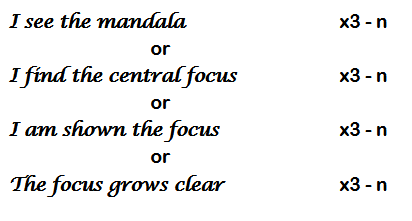
Region I: Ignition — Central Focus / Mandala

The first instrument reading that confirms the inner projector is beaming into Flickerspace. A dot, circle, or blob of phosphenic light appears at the centre of the screen — slightly brighter or darker than its surroundings, absolutely stationary when the head moves, moving with the gaze when the eyes move. This is the mandala: the first projection of the brain’s own subjective light and imagery onto the ganzflicker field. Its appearance, however insignificant and unimpressive, is the moment of ignition. The engines have fired and the craft is about to leave the launchpad.
Watch the mandala with the quiet attention of a pilot checking the instrumentation on the dashboard. It will fluctuate — brightening and darkening in slow alternation, phasing in and out between light and shadow. This is the first visible pulse of pendulation, the fundamental gravitational rhythm of Flickerspace. Everything that follows will move to alternating pendulating rhythms, moving between opposites.
Region II: Atmospheric Exit — Patterns / Tunnel

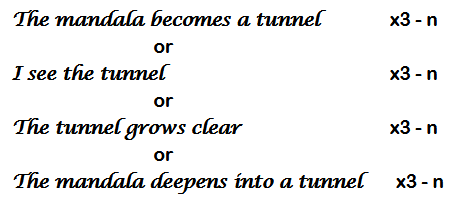
The craft breaks through the boundary layer between ordinary consciousness and deep Flickerspace. This is the Kluver trance-ition. Elementary geometric forms — dots, rings, spirals, honeycomb, cobweb — begin to populate the screen. With deepening absorption these more circular and concentric, organising themselves around the mandala, which now develops depth and three-dimensional perspective, opening into a vortex or tunnel of light.
Unlike the mandala from which it emerged, the tunnel no longer moves with the direction of gaze. It possesses its own visionary reality, independent of the observer. There is a sense of being drawn forward into it, of the tunnel enlarging to fill the entire screen, of passing through something. The familiar red world of the surface is now behind you. You are no longer in the atmosphere of ordinary perception. You are entering Flickerspace.
Region III: Orbit — Luminous Mist / Shadowy Shapes
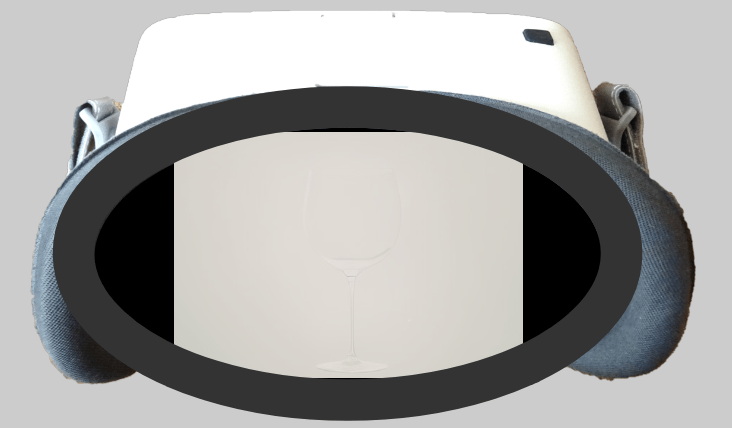
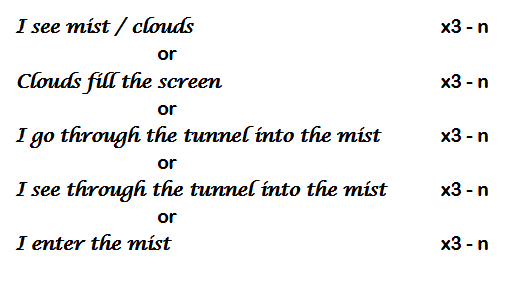
The craft has achieved orbit. Weightlessness — a felt sense of suspension and dissolution — characterises this region. The red screen has become a uniformly grey or whitish luminous mist, and within the mist the first shadows of shapes begin to emerge: vague silhouettes, often small and seen as though at a great distance, sometimes a single isolated object emerging briefly into identifiability before dissolving back. The mist does not flicker. You have found the space between the pictures.
This region is the first proper experience of altered-state space, and experienced strobonauts often hang out here for prolonged periods, enjoying a bit of refreshment. There is no need to rush forward. Any impatience is counterproductive. Orbit is where the craft stabilises. It is from the stability of the luminous mist that the deeper regions become accessible. Work the flicker jumps from here, pump up the brightness of the mist with occultation.
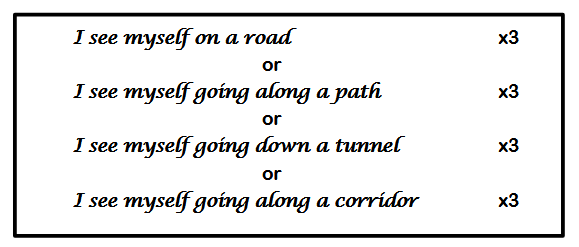
Region IV: Interplanetary Space — Scenes / Settings

This is the psychodynamic heartland of the voyage, where the brain begins presenting what most needs to be processed: themes from earlier life, emotionally charged material, imagery connected to the Emotional Operating Networks of the deep brain. The observer perspective — seeing a figure of self in the filmstrip rather than inhabiting it — is the craft’s natural position in this region. It allows the brain to elaborate a great variety of versions of the self: young and old, strong and weak, light and shadow, angelic and bestial. Each version carries information. The Narrator names what it sees. The Embodier registers what it feels.
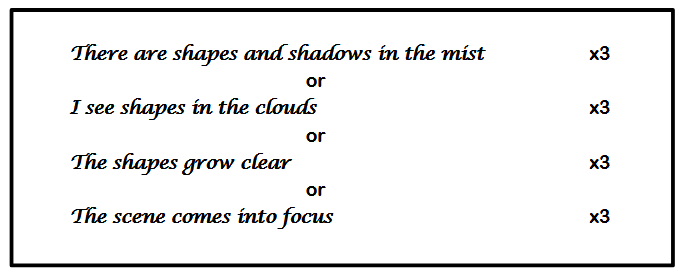
Region V: Interplanetary Space — Filmstrips
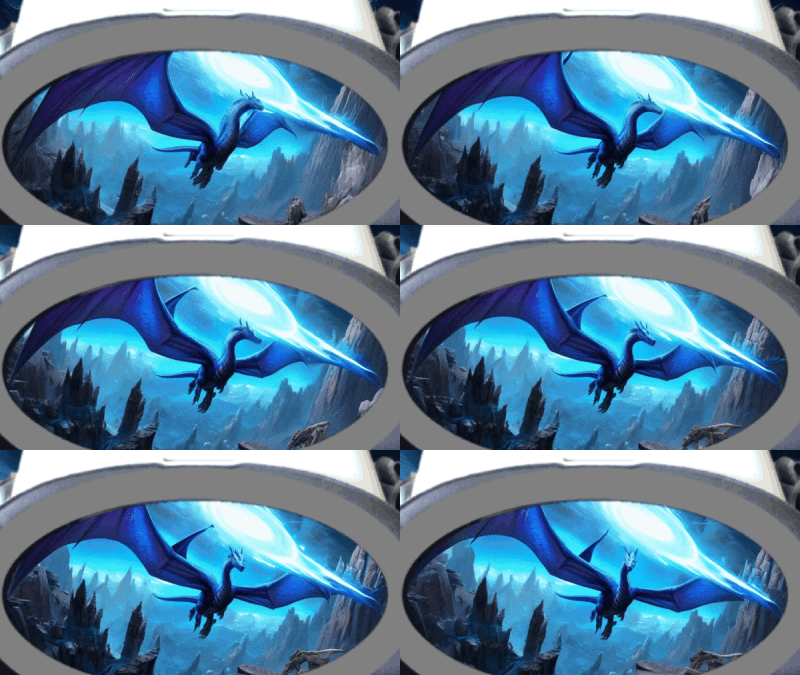
The craft is now cruising through the inner solar system of the psyche. There is narrative here, and drama, and a recognisable self — a figure seen from an observer’s perspective, moving through settings, engaged in sequences of action. The visions have the quality of filmstrips: condensed and concertinaed, as though long sequences of visual narrative have been compressed together, switching location, morphing figures, blending fantasy and memory. The physics of this region is the physics of the dream — not the logic of waking life but something more fluid, more associative, more symbolically charged.

Region VI: Interstellar Space — Numinosum
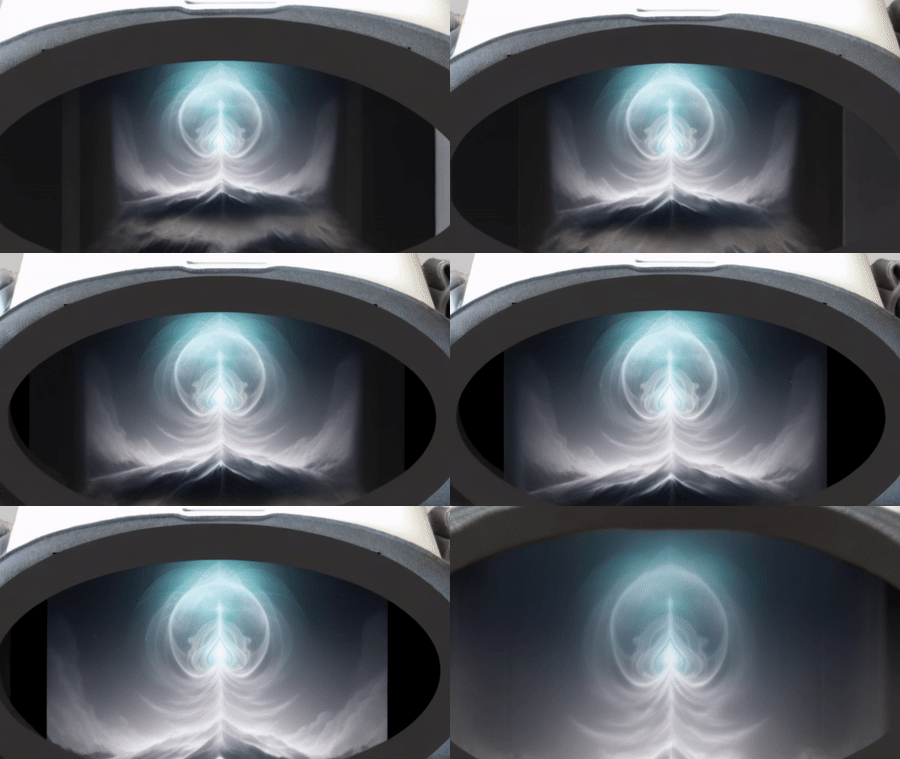
Increasingly condensed complexity becomes numinosity and luminosity. Swept up into the visions and carried along, often as though floating or flying, with progressively diminishing ego-involvement. Experiences of ascent, great height, awesome size and immense space, may develop into hypercomplex multidimensionality and interconnectedness. It may begin with the impression that two or more realities are superimposed upon one another, or interpenetrate, as the visionary material becomes increasingly translucent, condensed and concertinaed. The visions may interweave a flux of structural, mechanical, organic, animal-like, human-like and alien-like components,and be associated with strong numinous feeling tone. The emotion of awe evoked by numinous experiences, simultaneously both humbling and exalting, tends to be highly salutary.
Region VII: The Destination Star — Mystic Bright Light
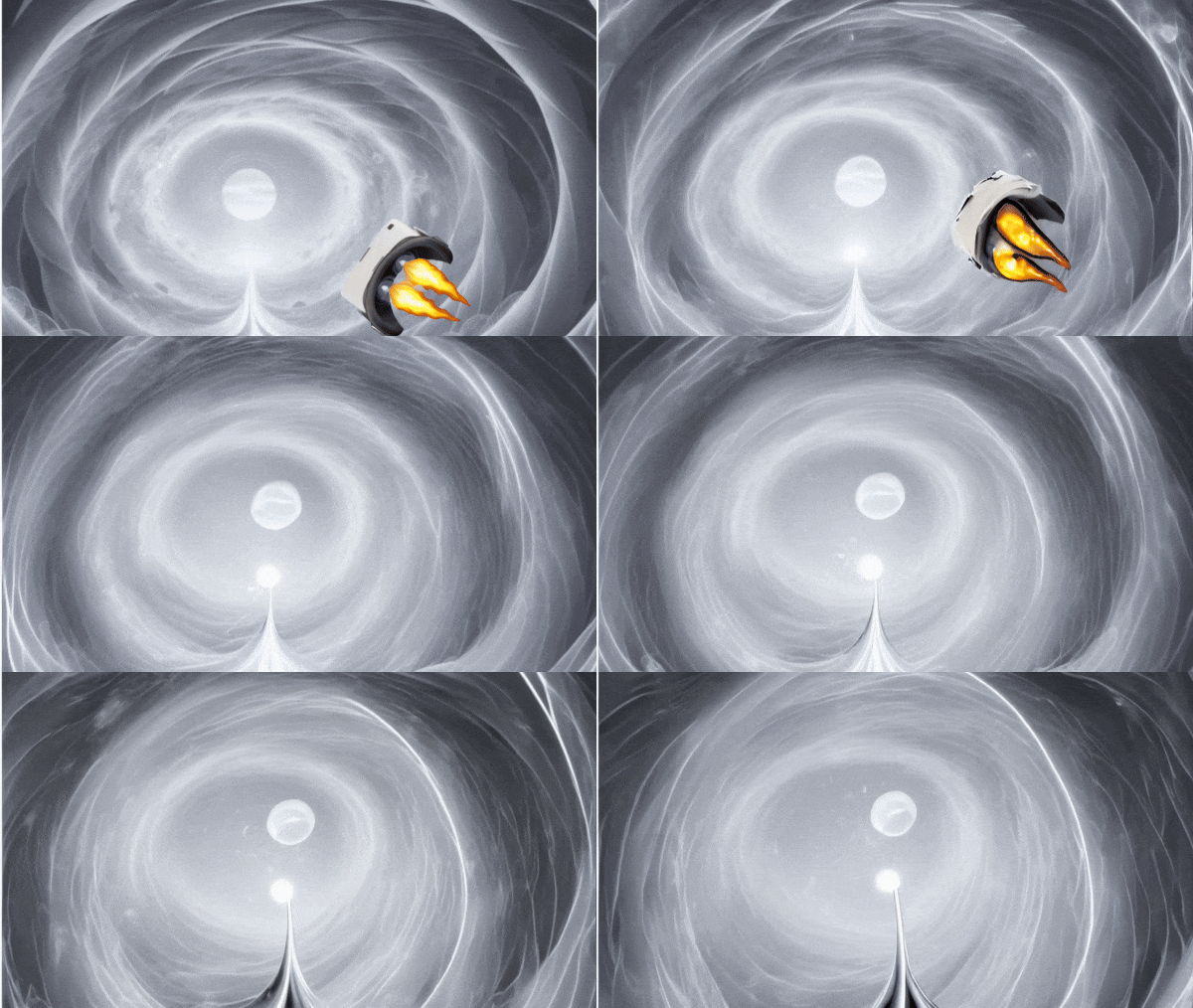
Visions of the numinosum, manifesting extraordinary structural hypercomplexity and multidimensionality, tend to merge into the mystical luminosity of Bright Light Experiences, though brightness and structural complexity can at times be dissociated. With regular practice of ganzflicker meditation over the long term, figures and objects are perceived as progressively more luminous. Bright Light Experiences become increasingly frequent and prolonged with the intensity of dazzling whiteouts attaining beatific luminosity and supplanting all thought and feeling.
Gate Gate Pāragate Pārasaṃgate Bodhi Svāhā
(“Gone, gone, gone beyond, gone altogether beyond, O enlightenment, hail!”)

 strobonaut.com