

Introduction: Echoes of the Astral Mythos
The journey through Flickerspace from launchpad to star fusion described here is both a map of ganzflicker‑induced visionary experience, and also a modern re‑telling of an ancient theme: the soul’s staged ascent to a luminous source. Across cultures and centuries, mystics have described journeys in which a vehicle carries the traveller through layered heavens or spheres toward an overwhelming light. The Strobonaut craft and its voyage to the Destination Star sit squarely in this lineage.
In Jewish Merkabah and Hekhalot mysticism, the visionary ascends through heavenly palaces and gateways in Ezekiel’s chariot‑throne, each level marked by guardians, lights, and trials, until reaching the blinding radiance of the divine glory. In Islam, the Prophet’s Miʿrāj describes him being carried by Buraq, a winged being swift as flashing lightning, on an ascent through the seven heavens, meeting earlier prophets at each stage before approaching the Divine Presence in a climax of light and nearness. Gnostic and Hermetic texts describe the soul rising through the planetary spheres, shedding cosmic influences, passing the fixed stars, and arriving at the transcendent One, often figured as pure light beyond all forms.
Plato’s Timaeus adds a particularly close image: each soul is assigned to a native star, to which it returns after a virtuous life as its blessed home. Later Platonists speak of the soul’s inward and upward turn through levels of reality until it is united with the Good, experienced as “light beyond light.” The Strobonaut’s Destination Star, reached after traversing mist, tunnel, complex personal scenarios and the transpersonal numinosum, echoes this idea of the soul’s true stellar home and final luminous union.
In the East the same theme recurs. The Upanishads describe the devayāna, the Path of the Gods, in which the soul of the knower passes through flame, day, sun, moon and lightning before a being “not human” leads it to Brahman; elsewhere the body is the chariot and the sun’s rays are the road upward. Pure Land Buddhism has Amitābha, “Infinite Light”, descend with his bodhisattvas to bear the soul on a lotus throne to the western paradise, while Tibetan texts urge the dying to follow the brilliant lights of the bardo, and Dzogchen thögal practitioners gaze at sky, sun or lamp to unfold visions of light that end in the rainbow body. In Taoist and Chinese tradition, the poet-shaman of the Chuci drives a dragon-drawn chariot to the Heavenly Gate, the Zhuangzi’s true person rides clouds and mounts the sun and moon, and Shangqing adepts visualise the stars and ascend on cranes and dragons, while The Secret of the Golden Flower teaches circulating the light itself.
Shamanic sky‑journeys use drumming and rhythm to propel the practitioner through multiple heavens toward a supreme sky deity or source of light; medieval and early modern seers gazed into fire, crystal, or mirror until a luminous cloud gave way to structured visions and angelic encounters. Modern near‑death and psychedelic reports add another layer: a tunnel, life‑review scenes, beings of light, and an overwhelming white or golden radiance.
Read in this light, the voyage of the Strobonaut through the seven regions of Flickerspace is both metaphor and map: a contemporary revisioning of the ancient cosmologies of ascent to the light.
Region 0: The Launchpad — Blank Screen
Region I: Ignition — Central Focus / Mandala
Region II: Atmospheric Exit — Patterns / Tunnel
Region III: Orbit — Luminous Mist / Shadowy Shapes
Region IV: Interplanetary Space — Scenes, Settings
Region V: Interplanetary Space — Filmstrips
Region VI: Interstellar Space — Numinosum
Region VII: The Destination Star — Mystic Bright Light
Region 0: The Launchpad — Blank Screen

No projection of visual imagery from the brain onto the ganzfeld flicker screen, which is seen as it is in objective reality. Red flicker of uniform hue covers the entire screen without any discernible lines, shapes, or shadows.
Region I: Ignition — Central Focus / Mandala

A dot, circle or blob is seen at the centre of the flicker screen, either of different brightness or colour from the rest of the screen. It may alternate between brighter and darker phases. If the head is moved it appears to remain absolutely stationary. If the eyes are moved, it moves with the direction of gaze. This is a phosphene, an entoptic phenomenon, arising from the structure of the visual system. When used as the focus of gaze fixation and meditation, visual imagery begins to be projected into it.
Region II: Atmospheric Exit — Patterns / Tunnel

Elementary forms and geometric patterns may fill the entire screen, e.g. dots, lines, rings, zigzags, cobwebs, mosaics, chessboard, honeycomb, textile patterns. These evolve into concentric arrangements centred on the mandala. As meditative absorption increases, the mandala enlarges and develops depth and 3D-perspective, becoming a vortex, rotating spiral or tunnel. There may be complex imagery such as a street or a river valley but still with a tunnel-like structure and perspective. Unlike the phosphene from which it emerged, such tunnel imagery does not move with the direction of gaze but instead possesses greater visionary reality. There may be a sense of movement into and along the tunnel, sometimes with associated feelings of ascent or descent and a corresponding brightening or darkening of the tunnel.
Region III: Orbit — Luminous Mist / Shadowy Shapes
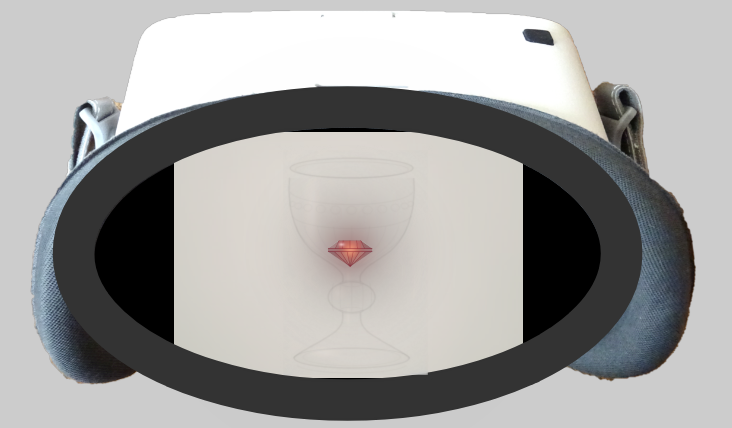
With sufficient induction of an empty floating state the red flicker screen blanks over to become a uniformly grey or whitish luminous mist. At times shadowy shapes begin to emerge from within the mist: very vague silhouettes to start with, sometimes small and seen as though at a great distance, sometimes a single isolated object emerging briefly from translucency into identifiability before dissolving back. The object may be symbolic and archetypal. The mist does not flicker — it fills the spaces between the light flashes. There may still be a central focus of heightened colour or detail.
Orbit is where the craft stabilises. One can hang out in the mist in a weightless suspended state for indefinite periods of time. It is from the stability of the luminous mist that the deeper regions become accessible. Work the flicker jumps from here.
Region IV: Interplanetary Space — Scenes / Settings

You begin to see identifiable scenes. They have the familiar feel of occurring on the surface of a planet — indoors, outdoors, under the sea, underground. The scenes may be quite small as though seen from an aerial perspective. This is the psychodynamic heartland of the voyage, where the brain begins presenting what most needs to be processed: themes from earlier life, emotionally charged material, often condensed and symbolically disguised as in nocturnal dreams. The observer perspective — seeing a figure of self in the filmstrip rather than participating in it — allows the brain to elaborate a great variety of versions of the self: young and old, strong and weak, light and dark, male and female, angelic and demonic, modern and ancient. Allowing each version to act out whatever it needs to without interference neutralizes emotional disturbance and brings insight.
Region V: Interplanetary Space — Filmstrips
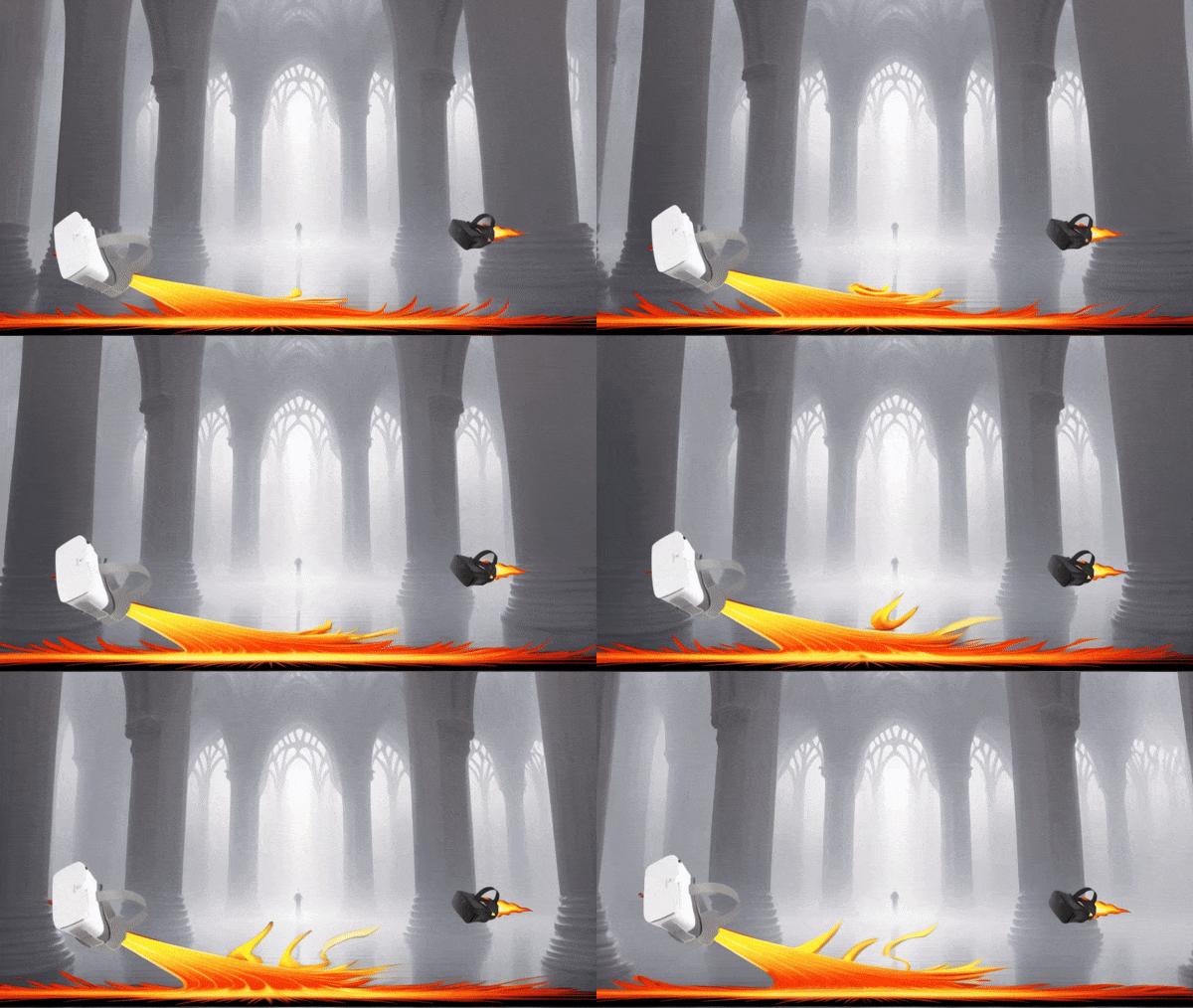
The craft is now cruising through the inner solar system of the psyche. There is narrative here, and drama, and a recognisable self — a figure seen from an observer’s perspective, moving through settings, engaged in sequences of action.
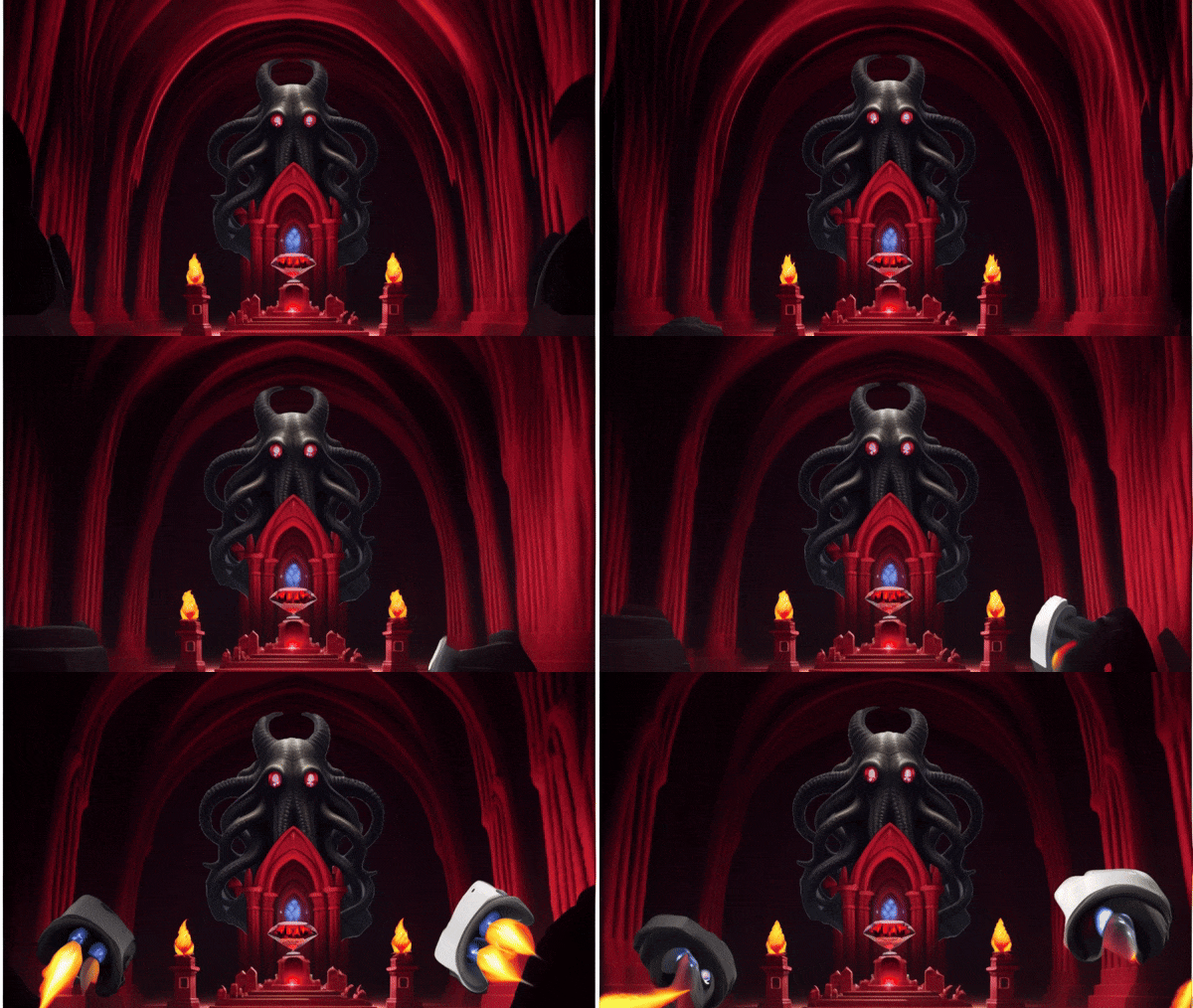
During a trip the emotional networks of the deep brain, and all the monsters that live there, need to play themselves out at this interplanetary level before ascent into interstellar space is possible. The visions have the quality of filmstrips: condensed and concertinaed, as though long sequences of visual narrative have been compressed together, switching location, morphing figures, blending fantasy and memory. The physics of this region is the physics of the dream — not the logic of waking life but something more fluid, more associative, more symbolically charged.
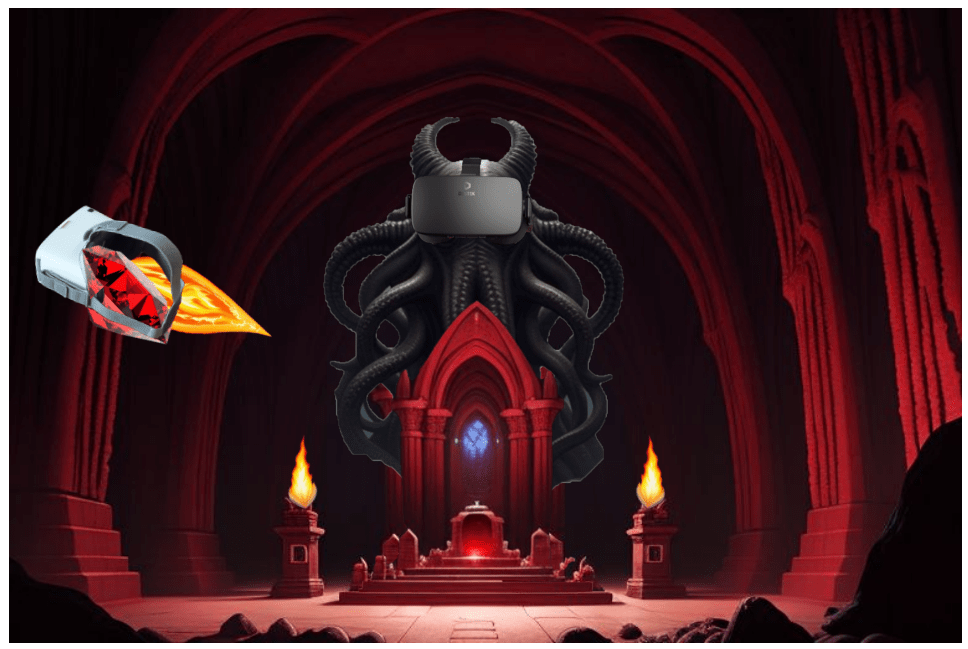
Once sufficient autogenic neutralization of emotional disturbance has occurred the imagery gets brighter and themes of vertical ascent become prominent. Figures and objects may be seen to be levitating and floating skywards, or there are visions of climbing a soaring pillar, tree or mountain peak. There develops a recognisable sense of vastness, upward movement and increased luminosity signalling the shift from personal to transpersonal levels.
Region VI: Interstellar Space — Numinosum
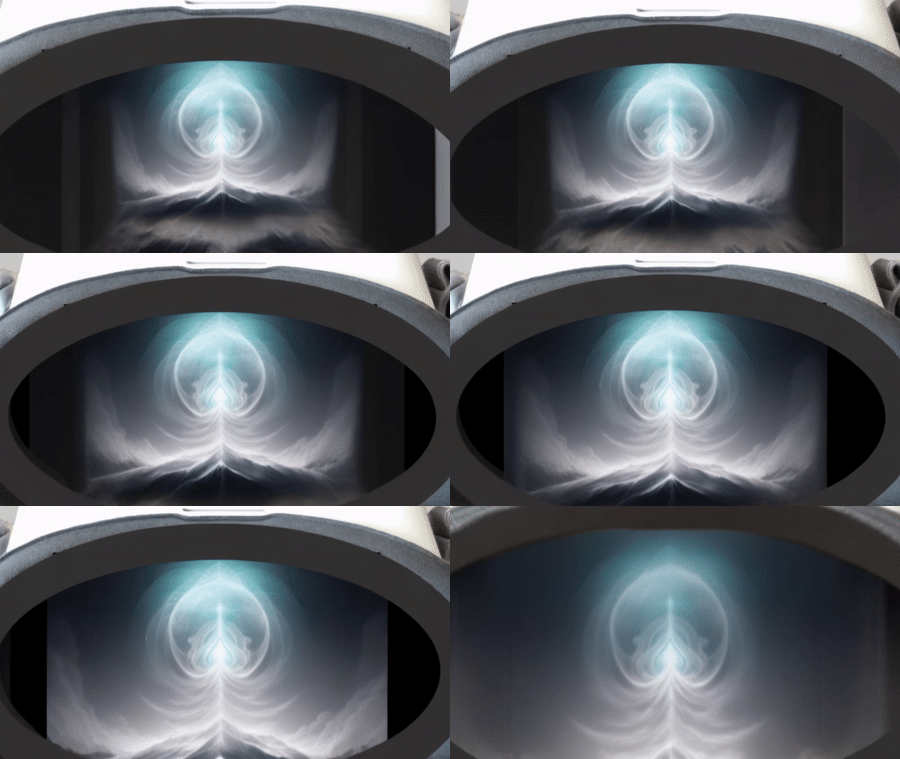
The imagery no longer has the familiar feel of occurring on the surface of a planet in ordinary reality. It is experienced as up in outer space, or in another dimension, or in a spirit world.
Increasingly condensed complexity becomes numinosity and luminosity. Swept up into the visions and carried along, often as though floating or flying, with progressively diminishing ego-involvement. Experiences of ascent, great height, awesome size and immense space, may develop into hypercomplex multidimensionality and interconnectedness. It may begin with the impression that two or more realities are superimposed upon one another, or interpenetrate, as the visionary material becomes increasingly translucent, condensed and concertinaed. The visions may interweave a flux of structural, mechanical, organic, animal-like, human-like and alien-like components,and be associated with strong numinous feeling tone.
The emotion of awe evoked by ganzflicker-induced numinous experience, simultaneously both humbling and exalting, is highly therapeutic and salutary to the ego.
Region VII: The Destination Star — Mystic Bright Light
Visions of the numinosum, manifesting extraordinary structural hypercomplexity and multidimensionality, merge into the mystical luminosity of Bright Light Experiences. Characteristic of this luminosity is its power to hold the attention, a perceived supreme significance. With regular practice of flicker jumps during ganzflicker meditation, figures and objects are perceived as progressively more luminous over the long term. Bright Light Experiences become increasingly frequent and prolonged as sufficient number of flicker jumps are carried out, attaining a beatific luminosity which supplants ego-based thought and feeling.

© Copyright REM Autogenics – All rights reserved

